

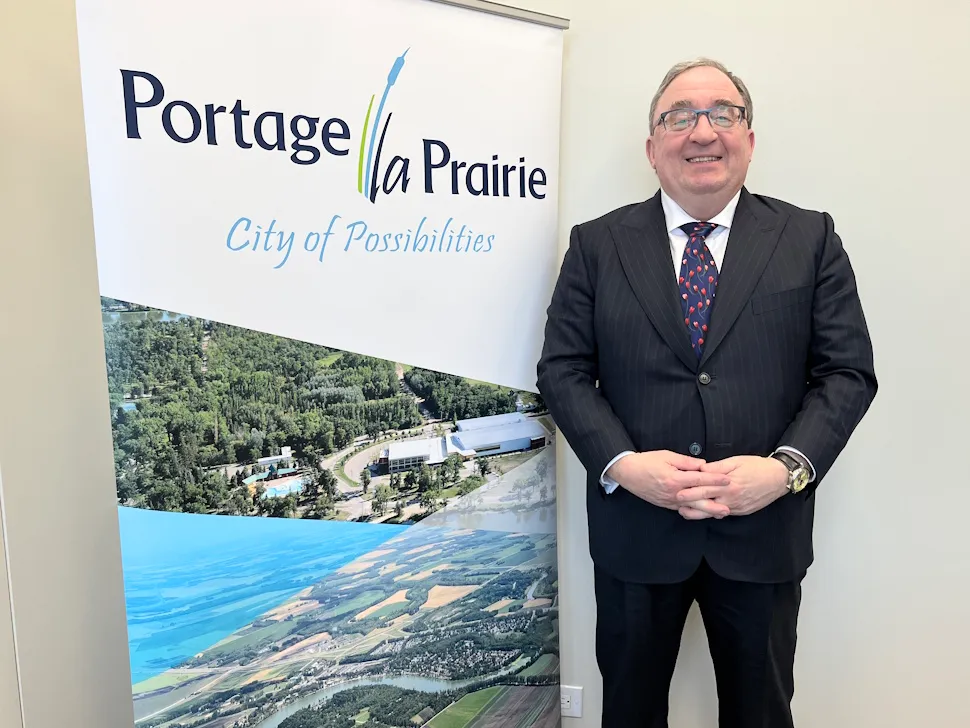
Portage la Prairie Councillor and Manitoba Federation of Canadian Municipalities (FCM) Board Member, Joe Masi, is calling for faster federal infrastructure funding and new revenue tools for municipalities following the Government of Canada’s 2026 Spring Economic Update.
Masi said timely investment is critical for communities like Portage to move projects forward and support economic growth, get homes built, and renew municipal infrastructure.
“We really want to see infrastructure funding flow quickly. For every billion dollars of municipal infrastructure, it generates $1.8 billion in economic impact and supports 9,000 jobs,” notes Masi.
He said that kind of return highlights the broader economic benefits tied to local infrastructure spending.
Infrastructure needs across communities
Masi pointed to growing infrastructure demands across the country, noting many systems are aging or in need of replacement.
“When you look at municipal infrastructure right now in Canada, about 40 per cent of local infrastructure like water and wastewater infrastructure, is in poor condition,” he notes
Related stories:
- Portage Council advances municipal tax hike proposal
- Thinking of running for mayor? Registration opens Friday
- ▶️ Listen to this news story on the radio: Country 93 / Mix 96 / CFRY 920
He stressed that municipalities need programs that are both responsive and efficient to address those gaps.
“FCM appreciates programs like the Build Communities Strong Fund and want to be a good partner with the federal government going into the 2026 budget. Projects like the City of Portage expansion of our water treatment plant, and others, are examples of good projects, shovel ready and will deliver the goals the federal government wants to achieve,” said Masi.
Challenges for smaller communities
Masi also raised concerns about how funding is distributed, saying smaller communities often struggle to compete with major urban centres.
He said larger cities naturally have significant needs, but rural municipalities and smaller communities like Portage face unique challenges.
“It's very difficult to compete with Toronto, Vancouver, and Montreal. They have big needs as well,” mentions Masi.



Masi added that while smaller communities represent a smaller share of the population, they are responsible for a significant portion of infrastructure.
“They have 15% of the people in Canada, but they look after about 36% of the infrastructure,” notes Masi. That is why FCM is calling for a separate stream of infrastructure funding dedicated to smaller communities like Portage.
Looking beyond property taxes
Masi said FCM is also pushing for changes to how municipalities are funded, noting a heavy reliance on property taxes must be addressed.
“We just did our financial plan on Monday as a city,” says Masi. And it is an excellent plan for Portage, but we are limited, like all municipalities on an over reliance on property taxes, making it difficult to undertake major infrastructure projects on our own.
He explained that property taxes make up the majority of municipal income, alongside government transfers.
“We get 55 per cent of our revenue from property taxes and 26 per cent from government grants. So 81 per cent of our revenue comes from either property taxes or other government grants from the federal and provincial governments,” adds Masi.
That reliance on property taxes, he said, makes it difficult to fund large-scale projects without support from other levels of government or new revenue sources.
“In Portage of Prairie, if we raise property taxes one per cent, it generates $144,000,” continues Masi. “To start building big infrastructure projects just on property taxes would be difficult on the property tax bill."
Push for new revenue sharing
Masi said one potential solution is providing municipalities with a share of the federal GST to create a more stable funding stream.
“We think the fastest way at the federal level to help municipalities with other revenue is a share of the GST,” mentions Masi.
He said that approach would allow municipalities to better plan and deliver projects.
“Because then you get it, it's banked, you can plan every year, and you can do infrastructure projects knowing you're going to get those dollars,” notes Masi.
He added that current funding models often involve lengthy application processes with uncertain outcomes.
“Right now, you put an application in, and it sits, and it waits, and then you could be denied, and then you've got to redo all your plans and how you're going to fund it,” says Masi.
Masi said municipalities will continue advocating for both faster approvals and more predictable funding as discussions move toward the 2026 federal budget.


















 Sun, May 3, 10:14 AM


 Full-time, Agriculture, Labour
 Featured